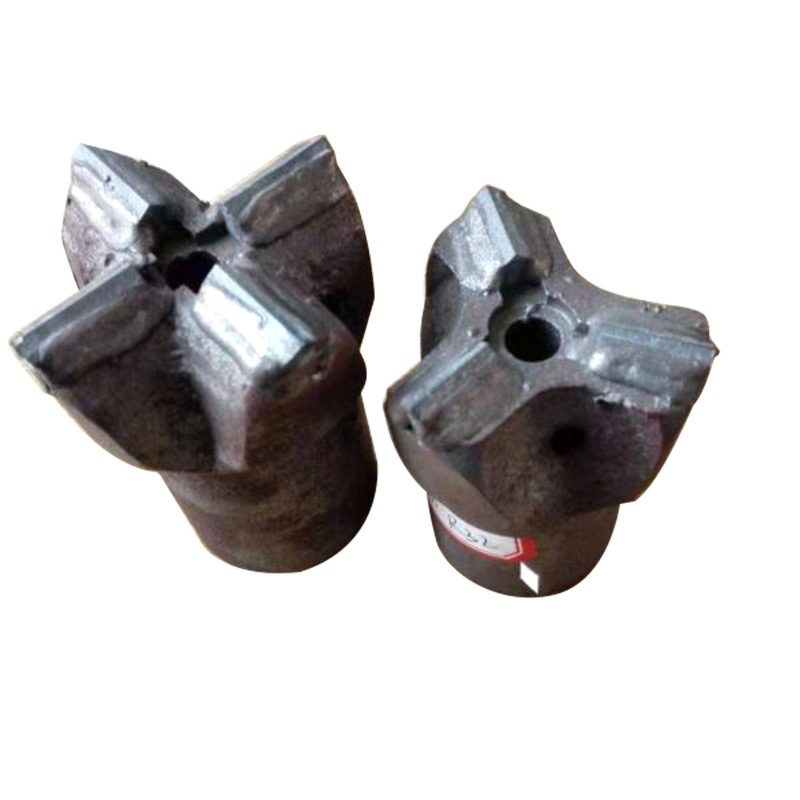
Ask a steel plant what it spends on cast house drilling cost and you will usually get the price of a bit. That number is the least useful figure in the budget. The money that actually leaves the plant is spread across four wear parts that work as one system – the bit, the rod, the adapter and the connector – and the way each of them fails decides whether taphole drilling is a small consumable line or a recurring source of downtime.
Part 1: the bit
The bit is the visible cost and rarely the largest one. A taphole cross bit or button bit typically opens a number of holes before it stops cutting cleanly, and the warning signs are consistent: slower penetration, more heat, a polished rather than cut hole. Wear reading matters more than wear itself – our guide to six wear patterns and what they mean explains how a rounded gauge, a chipped insert and an eroded body point to three different causes.
What a plant should track: holes per bit, penetration time per hole, and the reason the bit was retired. If bits are retired because the operator wanted a fresh one rather than because the tool had stopped cutting, the consumable budget is paying for confidence rather than for work.
Part 2: the rod
The rod is where geometry and metallurgy meet the furnace. It carries impact, torque, heat and, in a bad day, a stuck bit. Two things shorten its life: a bend that was never straightened, and a grade that is wrong for the load. Straightness is not cosmetic. A bent rod drills an oval hole, loads the taphole unevenly and transfers shock into the joint – which is why the basics of rod structure and load characteristics are worth re-reading before the next grade change.
Part 3: the adapter
The adapter is the part that most plants forget to inspect. It is also the part whose failure stops production fastest, because a broken adapter stops the string from being pulled or seated. Shank life is a maintenance subject in its own right – the small parts and how they fail are covered in shank adapters and striking bars – and it is one of the few places where a five minute inspection genuinely prevents a lost cast.
Part 4: the connector or coupling
Connectors and coupling sleeves carry the full vibration of the string and are usually the first to show thread damage. A loose thread is not a fitting problem, it is a breakage waiting to happen, and the mechanics are well documented in our article on why coupling sleeves fail and how to make them last. Thread tolerance, cleanliness and matched wear are the three variables a plant can control.
Adding the four into one useful number
The number to report is cost per taphole opened, and it is built from five inputs:
- bits consumed per 100 holes
- rods consumed per 1,000 holes
- adapters and connectors consumed per year
- labour and drilling machine time per cast
- the cost of a delayed or lost cast
Most plants know the first number and guess the rest. The guess is usually wrong in a helpful direction: when the arithmetic is written down, cheaper bits often cost more per hole than the alternative, and the repair budget appears in a line nobody was tracking. Our cost per metre guide shows the same calculation for drilling in general.
Frequently asked questions
Which wear part costs the most over a year?
It depends on the plant, but the ranking is usually rods and connectors before bits, because a single failure there stops a cast while a dull bit merely slows one.
How do we cut cast house drilling cost without risking the taphole?
Match parts to the machine and the clay, keep sets in the same wear state, inspect adapters and connectors, and buy on cost per hole with a supplier who can hold tolerances across batches.
Start with what you already throw away. Photograph the last four bits, rods or connectors you retired and send us the photos with your taphole diameter and clay type – we will tell you which of the four wear parts is really spending your budget.