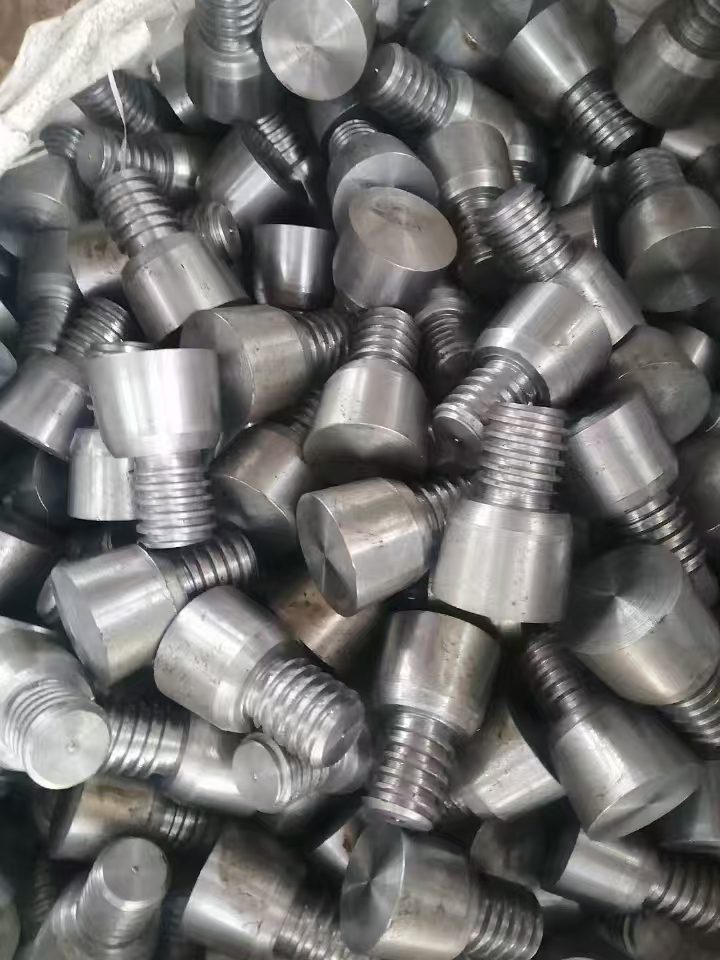
Every blow a top hammer delivers passes through one short piece of steel before it reaches the rock: the shank adapter. It has no cutting edge, no carbide and no glamour, and when it fails the rig stops just as completely as it would with a broken bit. Yet it is the part most often left out of a purchase specification.
What a shank adapter does
The shank adapter – also called a shank piece, striking bar or chuck adapter, depending on the maker – sits between the rock drill and the first rod. It has three jobs:
- Receive the piston blow on a hardened strike face and pass it into the rod string without deforming.
- Transmit rotation from the drill’s rotation unit into the rods, usually through splines or a profiled section.
- Pass flushing fluid from the machine’s swivel into the rod bore.
It must do all three while being hammered thousands of times per shift, hot and wet, with the full torque of the string passing through it.
How shank adapters fail
Spline wear. The splines are where rotation is transmitted. As they wear, backlash grows, the adapter rattles in the rotation unit and the joint gets noisier. Worn splines also shift the load onto fewer teeth, which accelerates the wear.
Strike face deformation. Mushrooming or erosion of the strike face absorbs part of each blow and turns it into heat instead of rock breakage. You cannot see it from the operator’s seat, but you can measure it with a straight edge.
Cracking at the shoulder or spline root. The classic fatigue failure. It starts at a stress riser and grows quietly until the adapter breaks – almost always at the worst possible moment.
Thread damage. Cross-threading, galling and corrosion in the front thread, which is where the adapter meets the first rod. A damaged adapter thread damages the rod thread too.
Specifying the right one
The shank adapter is machine-specific before it is anything else. To specify correctly you need:
- The rock drill model and its rotation unit, which determines the shank profile and spline count or shape.
- The front connection – thread or taper – which must match your rods exactly. This is the same discipline described in our thread matching guide.
- Length, which affects how the drill’s feed and the rod string line up.
- Flushing bore and porting, matched to the water or air volume the machine delivers.
- Material and heat treatment, chosen for the impact energy of the drill. An adapter hardened for a small hammer will crack behind a large one, and an unhardened one will deform.
Care habits that pay
Keep the splines and the front thread lightly lubricated, and clean them before every change – grit in a spline is a lap that cuts every revolution. Rotate two or three adapters between shifts so wear is shared rather than concentrated. Check the strike face with a straight edge at every rod change: if it is no longer flat, it is already costing you energy. And never use a worn adapter to break in new rods; the wear transfers.
Record when each adapter is retired. The interval is the most useful indicator you have of whether impact energy is being delivered efficiently down the whole string, and it sits alongside the other joints in the chain – the coupling sleeves behind it and the rod shanks in front of it.
Frequently asked questions
Is a shank adapter the same as a coupling sleeve?
No. The shank adapter couples the drill to the rod string and receives the piston blow; a coupling sleeve joins one rod to the next. They meet different loads and wear differently.
How often should a shank adapter be replaced?
On measurement, not on hours. Retire it when the splines show visible backlash, the strike face is no longer flat, or any crack is visible at the shoulder. As a rule of thumb, expect it to be replaced several times over the life of a rod string.
Can a cracked adapter be welded?
No. Welding a hardened, high-impact part introduces a new stress riser and destroys the heat treatment. A repaired adapter is more likely to break than the one you removed, and it takes the rods with it.
Send us your drill model, rod connection and the flushing you run, and we will supply shank adapters and rods made as one system – so the blow that leaves the piston arrives at the rock instead of heating up a joint.