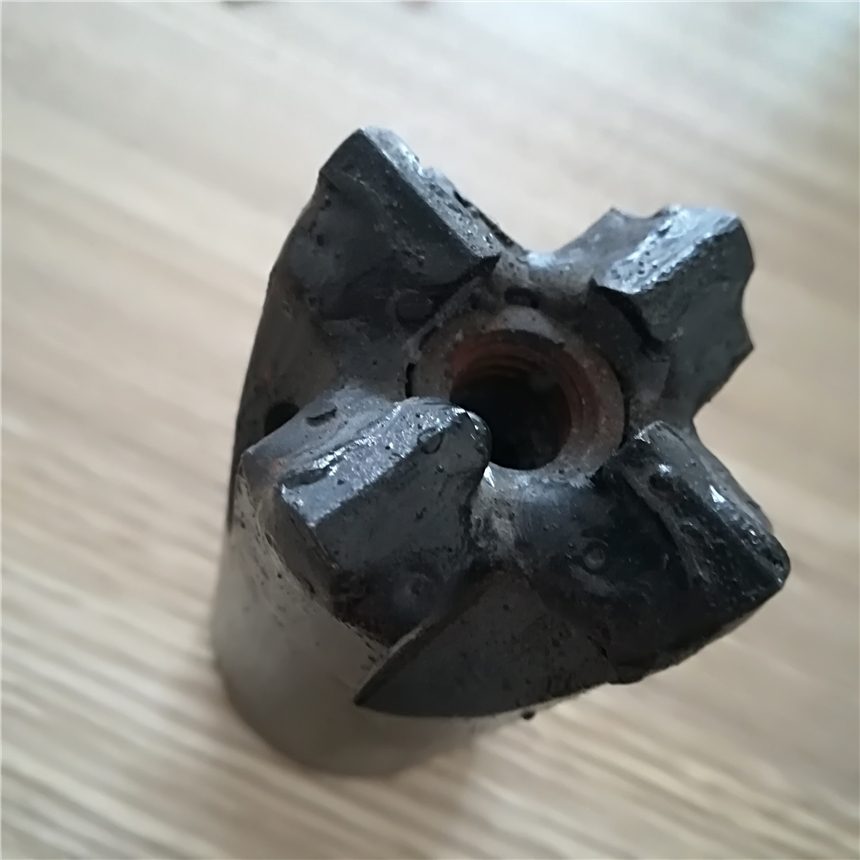
Blast furnace drill bits are small, consumable, and easy to buy badly. The bit has one job – open a taphole that has been sealed with clay – but it does that job against a mixture of sintered clay, coke, slag and heat, at the end of a long tool string, with a crew waiting on the other side. A bit that looks cheap on the invoice can be the most expensive item in the cast house if it loses teeth on the first hole or stalls halfway through the second.
What the bit actually has to cut
A rock bit usually meets a relatively uniform formation. A taphole is not uniform. The clay has been baked by the furnace, mixed with coke and slag, and the channel is surrounded by a temperature gradient that rises steeply toward the iron. The bit crosses soft and hard bands in the same hole, and the abrasive particles wear the steel body as well as the carbide.
Heat is the second difference. The cutting face sits close to liquid iron, and the steel shank conducts heat back toward the machine. Water must reach the face continuously, both to cool the carbide and to carry clay out of the flutes. A blocked water hole does not simply slow the drill; it can destroy the bit in one pass. A taphole bit is therefore a cooling tool as much as a cutting tool.
The parts that make up a taphole bit
- Bit body: usually a 42CrMo or 40Cr forging, quenched and tempered for a balance of strength and toughness.
- Carbide inserts: YG8, YG11C or similar grades, often coarse-grained for shock resistance rather than maximum hardness.
- Flutes: one-wing, cross, three-wing, four-wing or spiral, depending on how the clay breaks and how much clearance the hole needs.
- Water holes: a central passage and side ports that deliver coolant to the cutting edges and flush the flutes.
- Thread: R32 or R38 trapezoidal thread, commonly left-hand so that the bit tightens against the rotation used for withdrawal.
- Drill rod: hollow hex steel or thick-wall tube that transmits impact, torque and water without adding unnecessary bending.
These parts are a system. In the field, a high proportion of short lives are not caused by a worn tip at all. They come from a blocked water hole, a damaged thread, a bent rod or a bit that was never aligned with the taphole. Buying a harder insert will not fix any of those.
Head geometry: what each style is for
There is no universal winner. Each head shape makes a different trade between centering, cutting speed, flushing and cost.
- One-wing or chisel: simple and low cost, but limited centering and slower in hard clay.
- Cross: four cutting edges, good centering and good flushing, which is why it is the general-purpose choice in many cast houses.
- Three-wing or four-wing: more carbide and faster cutting in hard, well-sintered clay, with better resistance to deviation; the trade-off is higher torque and a greater demand on the rod and machine.
- Button: rounded inserts resist shock and abrasion, but are less aggressive in soft, sticky clay.
- Replaceable head: reuses the rod and shank and lowers stock cost, provided the head-to-rod interface is made to a consistent standard.
The choice follows the furnace and the clay: taphole depth, clay strength, coke content, opening machine power, water pressure, and the crew’s habit. A hard, well-sintered clay rewards more cutting edges and a wear-resistant grade. A soft, sticky clay can benefit from more flute volume and a less aggressive head, because the problem is clearing the hole rather than breaking the clay. This is the same logic behind matching bit design to taphole clay.
What to check in the specification
A purchase specification for blast furnace drill bits should be short enough to be read and precise enough to be enforced. At minimum, it should state:
- Bit diameter and tolerance, plus the intended taphole depth range.
- Thread standard and hand (left or right), with a gauge or sample for verification.
- Carbide grade and insert geometry, including the exposed height and brazing standard.
- Water hole diameter, position and minimum flow at the specified pressure.
- Body material, hardness range and surface treatment.
- Marking, packaging and the batch traceability the supplier will provide.
The thread clause is not paperwork. A left-hand R32 connection supplied as a right-hand thread is scrap with a shipping invoice. The same applies to a bit diameter that is nominal rather than measured. Our guide to R32 left-hand threads explains the interface in more detail, and the manufacturing route from round bar to cross bit shows where the critical tolerances are set.
Failure modes and what they tell you
The way a bit dies is feedback. Read the pattern before changing the supplier or the grade.
- Insert cracking or loss: brazing voids, thermal shock or excessive feed. Inspect the joint, control the cooling cycle and match feed to the clay.
- Mushroomed or polished head: abrasive wear, too much speed or the wrong carbide grade. Try a coarser grade, reduce rpm and review the clay.
- Burned bit or blocked water: dirty water, a failed filter or no pressure interlock. Filter and flush the line, fit a pressure switch and check flow before every start.
- Thread damage or loosening: misalignment, over-torque or the wrong thread hand. Align the machine, control torque and verify the thread with a gauge.
- Bent rod or stuck bit: too much thrust, poor flushing or clay that is softer than expected. Stage the feed, improve flushing and withdraw earlier.
A bit that loses inserts at the braze line points to a joining problem. A bit that wears evenly to a mushroom shape points to grade or speed. A bit that fails at the thread points to alignment or handling. The failure mode is the starting point for the next purchase, not a reason to buy the most expensive bit in the catalogue.
Operation: water, alignment and feed
Most short bit lives are decided before the bit touches clay.
- Before start: confirm water pressure and flow, align the machine with the taphole, clean and inspect the thread, lock the bit, and check for missing or cracked inserts.
- During drilling: start at low speed to establish the hole, then apply impact, rotation and feed together. Reduce feed as the bit approaches breakthrough to avoid a sudden breakthrough and a spray of iron.
- On withdrawal: keep the water on, follow the machine procedure, and inspect the bit, thread and water holes before it goes back into the rack.
- After the tap: record hole depth, drilling time and failure mode. These three numbers turn a consumable into a managed item.
The standard operating procedure for taphole drilling covers the sequence in more detail, but the principle is simple: a bit that is aligned, cooled and fed correctly will outperform a harder bit that is forced.
The number that matters: cost per hole
The invoice price of a blast furnace drill bit is a poor comparison because it ignores how many holes the bit opens. A useful measure is cost per hole:
Cost per hole = annual spend on bits and rods / number of tapholes drilled in the year.
A bit that costs 20% less but drills 30% fewer holes has made the plant poorer. The same arithmetic applies to the rod, the shank and the time the crew spends in front of the runner. This is the argument behind the four wear parts that decide cast house drilling cost, and it is the reason cost per metre is a better benchmarking unit than price per piece.
Cost per hole also exposes the hidden cost of variability. A supplier whose bits average a good life but fail unpredictably is harder to plan around than a supplier with a slightly shorter but consistent life. Ask for a trial lot, run it on the same furnace and the same clay, and compare the distribution – not the best single result.
Where the technology is going
- Gradient carbides and tougher insert geometries that keep a hard surface and a shock-resistant core.
- Surface treatments and laser cladding on the body and flutes to reduce abrasive wear.
- Replaceable heads that reuse the rod and shank, cutting stock cost and shipping weight.
- Machine monitoring of torque, feed, water pressure and vibration to detect a blocked hole or a dull bit before failure.
- Life prediction from hole-by-hole data, moving maintenance from a fixed interval to a condition-based decision.
None of these changes the fundamentals. The bit still has to cut the clay, clear the hole, hold the thread and survive the heat. Technology improves the margin for error; it does not remove the need to match the tool to the furnace.
A system decision, not a spare part
Blast furnace drill bits are often bought as a spare part and treated as a price line. They are better understood as one component of a system that includes the clay, the rod, the opening machine, the water supply and the crew. Get the system right and the bit becomes predictable. Get it wrong and even an expensive bit will fail early.
The practical next step is narrow. Measure the hole, check the thread, confirm the water, and ask for a trial on cost per hole rather than a discount on the invoice. That is how a consumable becomes a controlled cost – and how the first cut into the taphole stops being a gamble. For the wider demand picture, see the market prospect for blast furnace taphole drilling tools.