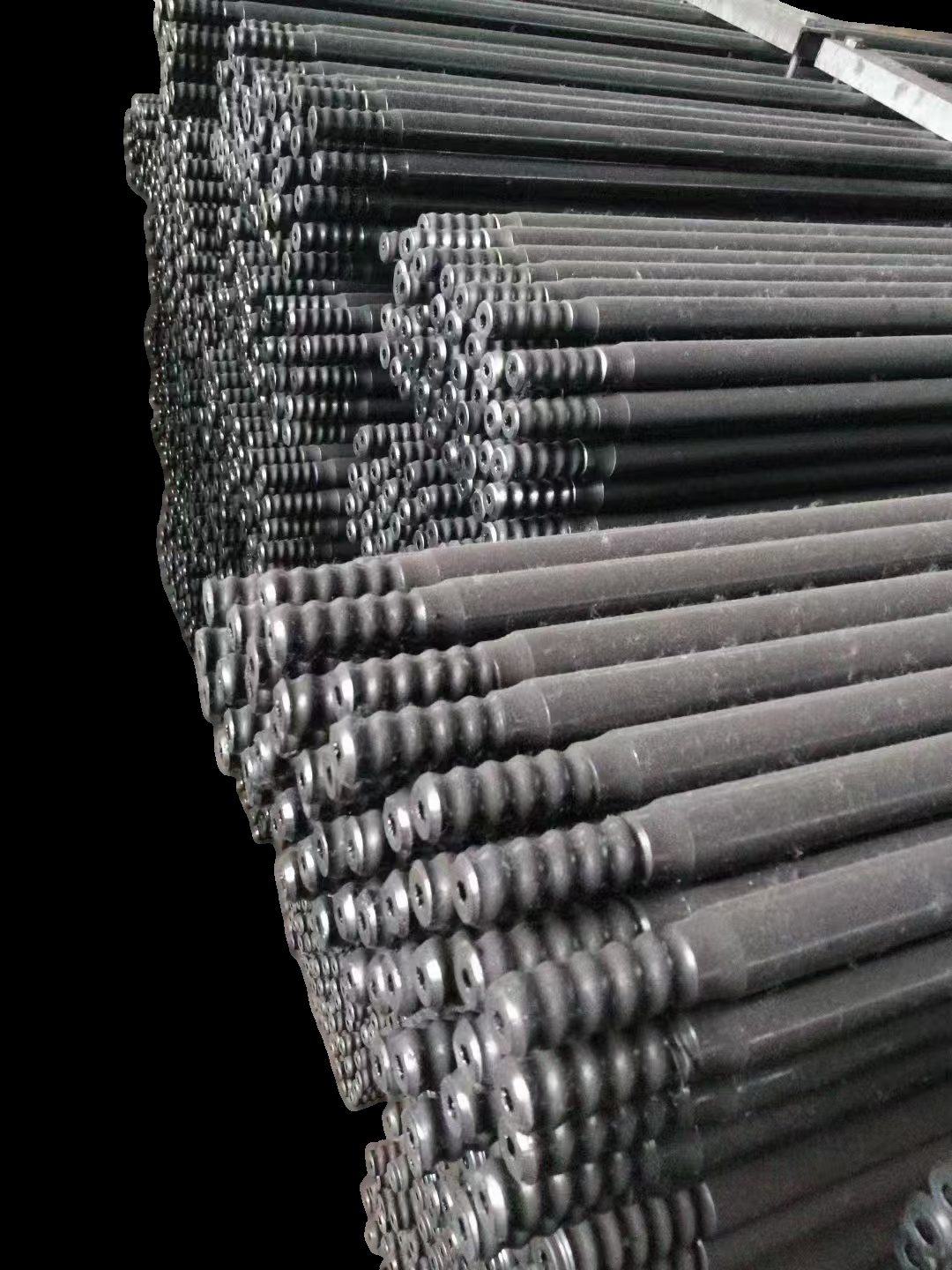
A tapered drill rod is the simplest connection in rock drilling: no threads to cross, no torque to set, just a machined cone that wedges the bit onto the rod. That simplicity is also why tapered rods are so easy to get wrong. Buy a rod whose taper does not match your bits and you will spend the shift re-fitting bits instead of drilling.
What makes a tapered rod different
Instead of a threaded joint, a tapered rod carries a male cone at the bit end and a matching female cone at the shank end. The bit is pushed on and held by friction plus the thrust of the hammer. Changing a bit takes seconds, which is why tapered equipment still dominates hand-held drilling, secondary breaking, dimensional stone and light bench work.
Three dimensions define a tapered rod: the shank that fits the hammer, the taper at the bit end, and the length and diameter of the rod body itself.
11 degree or 12 degree taper: what the number really changes
Both angles are used in the field. The difference is how the cone behaves under load:
- 11 degree tapers are shallower, so the contact area between rod and bit is larger. They grip firmly and are common where bits must stay put under heavy thrust and long collaring.
- 12 degree tapers release more easily. That suits operations where bits are changed constantly, for example when a driller works through several rock types in one hole.
What matters far more than the number is consistency: a 12 degree bit on an 11 degree rod (or the reverse) will either never seat or will hammer itself loose, damaging both parts. Never mix taper angles inside one drill string, and never buy bits and rods from different sources without a gauge check.
Choosing shank, diameter and length
The shank is dictated by your hammer, not by preference. Light hand-held rock drills commonly take a 22 mm hexagon shank (22 x 108 mm); heavier hand-held and light wagon drills often take a 25 mm hexagon shank (25 x 159 mm). Round shanks appear on some machines and on rods intended for rotary work.
Rod diameter follows the hole and the rock: a thicker rod is stiffer and straighter in broken ground, a thinner rod is lighter and cheaper to run in soft formations. Length is usually chosen from a standard ladder – commonly 0.6 m to 3.2 m – and the rule is to drill with the shortest rod that reaches the required depth, because rod whip grows with length.
Inspecting a tapered rod before you trust it
Half of all taper problems are visible in daylight:
- Taper surface: look for bright polished rings, scoring or a visible shoulder inside the female cone. A worn female taper is the most common reason a bit falls off.
- Straightness: roll the rod on a flat surface. A rod that wobbles will drill an oversized, drifting hole.
- Shank: check for hammer marks, cracking at the collar and ovality where the chuck grips.
- Flushing bore: blow through it. A blocked rod bore overheats the bit within minutes.
Handling rules that pay for themselves
Never hammer a bit onto a taper, and never use the bit itself as a drift to break the joint. Keep the cones clean and lightly oiled, store rods on racks rather than on the ground, and retire a rod the moment the taper shows a shoulder. A rod is a consumable; a hammer is not.
Frequently asked questions
Can I use a threaded bit on a tapered rod?
No. Tapered and threaded are two separate connection systems. The joint must match end to end, which is why we recommend ordering rods and bits together – see our matching guide.
How long should a tapered rod last?
Life is governed by the taper and the shank, not the body. In abrasive rock, expect the taper to wear out long before the steel does. Keep a spare rod and a spare bit on the rig so a worn taper never stops the shift.
Which steel is best?
Chromium-molybdenum grades such as 42CrMo are the usual choice for rods that see impact and bending, with plain carbon-manganese grades for lighter duty. We compare them in 42CrMo vs 40Cr drill rod.
Tell us your hammer model, hole diameter and the rock you are drilling, and we will specify the taper, shank and length that keep your bits tight and your metre rate high.