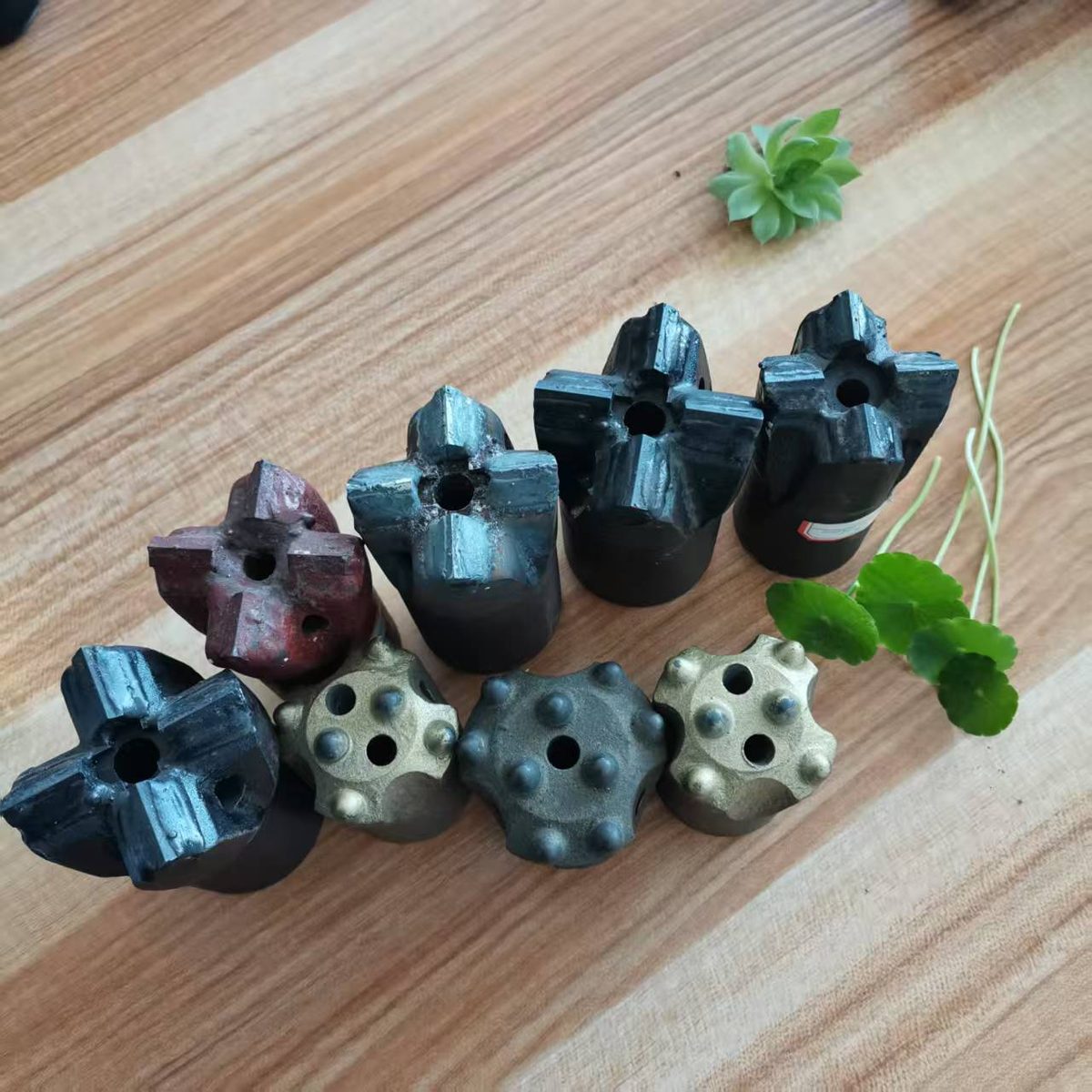
Open any drill bit catalogue and three shapes look back at you: the four-wing cross bit, the domed button bit and the flat chisel bit. They are not interchangeable, and picking the wrong one is one of the fastest ways to turn a cheap-looking purchase order into expensive downtime. This guide compares the three in plain terms: what each shape does, which ground it suits, and how to decide in five minutes on site.
The three shapes in one sentence each
Cross bit. Four cutting wings arranged like a plus sign, with tungsten carbide inserts or buttons set into each wing. Because the wings bite in four directions at once, the bit centres itself and drills a straight, round hole. It is the classic choice for blast furnace taphole clay, where you have to reach a precise point in the lining in a single pass.
Button bit. A domed or flat face studded with hemispherical carbide buttons. Instead of shaving the ground, the buttons crush it under impact and rotation. They can be reground several times, which is why button bits dominate hard, abrasive rock such as granite, basalt and hard limestone.
Chisel bit. One straight cutting edge, or a cross of two chisel edges, at the tip. Simple, inexpensive and quick in soft to medium ground such as clay, shale, coal and soft sandstone. It will not last in hard rock, and in bedded formations it tends to follow the seam instead of drilling where you aimed.
How to choose in five minutes
Ask four questions, in this order.
- How hard is the ground? Soft clay, mud-gun mix or coal points to a chisel bit or a light cross bit. Medium rock points to a cross bit. Hard, abrasive rock points to a button bit.
- Does the hole have to be straight and on size? If yes – taphole drilling, anchor holes, any hole that must line up with a second hole – the four-point support of a cross bit is worth more than raw speed.
- What is driving it? Impact energy, rotation speed and flushing pressure set the limit on what a bit can take. A bit built for a light hand-held hammer will chip quickly behind a heavy drifting rig.
- How much can you afford to stop? Button bits cost more per piece and less per metre in hard rock. Chisel bits cost less per piece and, almost everywhere else, more per metre.
Matching the bit to the rod is the other half of the job
Shape is only the first half of the decision. The second half is the connection: shank profile, thread type, diameter and length must all match the rod string, or the bit will either refuse to seat or work loose under vibration. If you are ordering both parts at once, start with our thread, diameter and length matching guide and take the measurements before you take the price.
Three mistakes we see every week
1. Button bits in clay. With nothing abrasive to keep them sharp, the buttons on a new button bit cannot bite into wet taphole clay. The bit spins, heats up and polishes instead of cutting. A cross bit does the same job for a fraction of the price.
2. Chisel bits in hard rock. A chisel edge in granite rounds off within metres and then does little except generate heat. If the rig gets louder without penetrating faster, stop and look at the bit.
3. Mixing wear states in one string. A new bit behind a worn one, or a worn bit behind a new one, bends the rod string. Both lives get shorter. Keep matched sets together.
Frequently asked questions
Is a cross bit the same as a four-wing bit?
Yes. Cross bit, four-wing bit and four-point bit describe the same family. Suppliers use the terms loosely, so always confirm the drawing rather than the name.
Can a button bit be resharpened?
Usually two or three times, provided there is still enough button height and no body washout. Once the gauge buttons are under diameter or the steel around them is eroded, regrinding only delays the replacement.
Which bit gives the cheapest hole?
Almost never the cheapest bit. Compare cost per metre including rig time: a bit that costs twice as much and drills three times as long is the better purchase. We show the arithmetic in our cost per metre guide.
Whether you open a blast furnace taphole twice a shift or drill anchor holes underground, the right answer is the bit that matches your ground, your rig and your deadline. Send us the rock description, the hole diameter and a photo of the bit that failed last, and we will tell you which of the three shapes fits – and why. Browse the full range on our news and product pages.