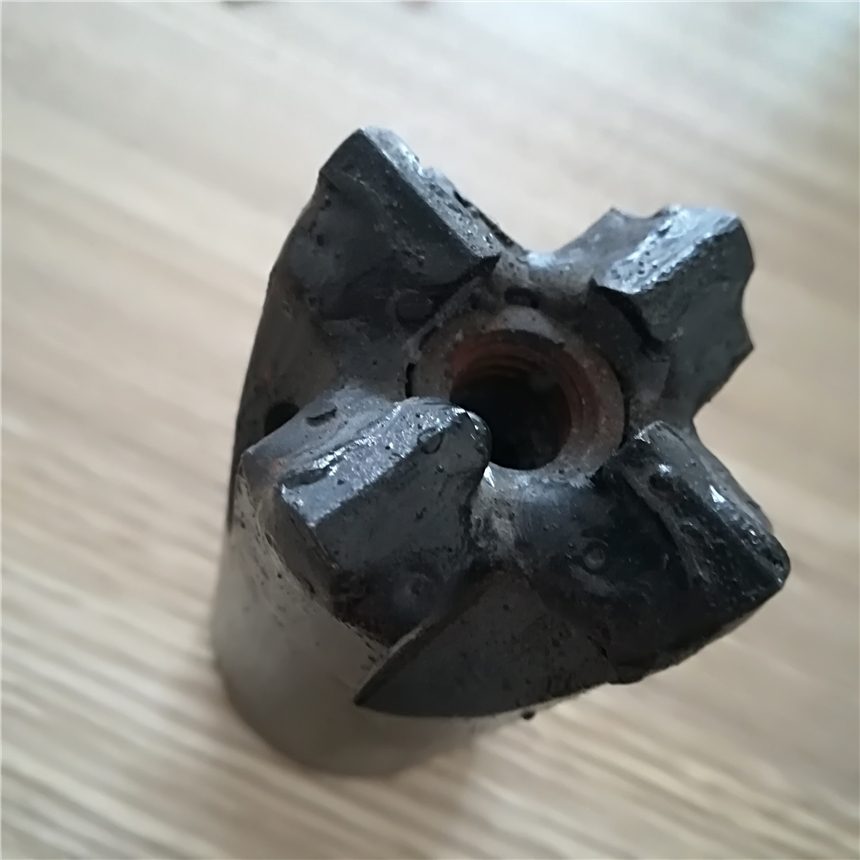
Taphole drilling is the least forgiving drilling job in a steel plant. The bit has one pass, a hot and abrasive mix in front of it, and a schedule that does not wait. That is why the taphole cross bit looks so specific: every feature on it exists to solve one of the problems the hole presents.
Start with what the bit has to cut
A taphole is not a single material. Depending on where the bit is in the pass, it meets:
- hardened tap-hole clay from the previous mud gun, which is abrasive and variable;
- consolidated mud and coke fines near the bore;
- the refractory lining itself, which is much harder and far less forgiving; and
- occasionally solidified iron or slag, which is a different problem entirely.
A bit that keeps a straight hole through all of that, at temperature, without wandering, is worth far more than its price. That is what the wing geometry is designed for.
Wing geometry: why four and not two
Four wings give the bit support in four directions at once. Instead of being pushed off line by a hard patch, the bit is held by the two wings on the opposite side. The result is a rounder, straighter hole and less side load on the rod.
Three details of the wing matter more than the number:
- Gauge diameter – the diameter swept by the wing tips. This sets the hole size and must stay consistent from bit to bit, because the mud gun and the tapping sequence are built around it.
- Relief behind the cutting edge – the body behind each wing is relieved so that only the cutting edge rubs the wall. Without relief, friction and heat rise sharply.
- Wing taper and rake – a steeper rake cuts faster in soft clay but is more fragile in the lining; a blunter rake lasts longer but needs more feed force.
Flushing: the centre hole is not a detail
The central flushing hole sits at the point where the wings meet. High-pressure water or air arrives through the rod bore, exits at the centre and travels back up the annular gap, cooling the cutting edges and carrying cuttings away. If that path is restricted, the bit heats up and the carbide goes quickly. Practical consequences:
- Keep the rod bore clear – a partially blocked rod is the most common cause of a burnt bit.
- Match water pressure to volume, not just pressure. High pressure with a thin stream cleans nothing.
- Check the hole after every used bit comes off. A deformed or plugged centre hole is reason enough to retire the bit.
Carbide selection for clay and lining
Taphole work needs a grade that resists impact more than a grade that resists abrasion. The buttons or inserts are brazed or pressed into the wings, and brazing quality decides whether they stay there: a poor braze fails at the interface long before the carbide itself is worn out. When a bit comes back with buttons missing but almost no wear on the survivors, look at the joint, not the grade.
Matching the bit to the rest of the string
A taphole bit is only as good as the rod behind it. Thread form, bore diameter and rod straightness all affect how the bit behaves in the hole, and a worn rod thread will let the joint work loose under the vibration of the pass. It is worth reading our explanation of how cross-type bits cut taphole clay alongside this article, and if you are specifying the whole string, start from the basics of BF rods and bits.
Frequently asked questions
How often should a taphole bit be replaced?
Replace on condition, not on a calendar: gauge still on size, wings not chipped, carbide present and the centre hole clear. Most plants retire a bit when the gauge drops below the size the tapping sequence needs.
Is a three-wing bit ever better?
Three-wing and three-button configurations exist mainly for button bit designs and can drill faster in some rock. In taphole clay the straightness and support of a four-wing bit usually wins – see the comparison in 3-button versus 4-button bits.
Can a taphole bit be reground?
The carbide can sometimes be re-profiled, but the wing tips are the gauge, so grinding them changes hole size. Treat regrinding as a specialist operation, not routine maintenance.
Send us your taphole diameter, clay characteristics and opening machine details, and we will specify the wing geometry, gauge and carbide grade for your furnace rather than a generic catalogue bit.