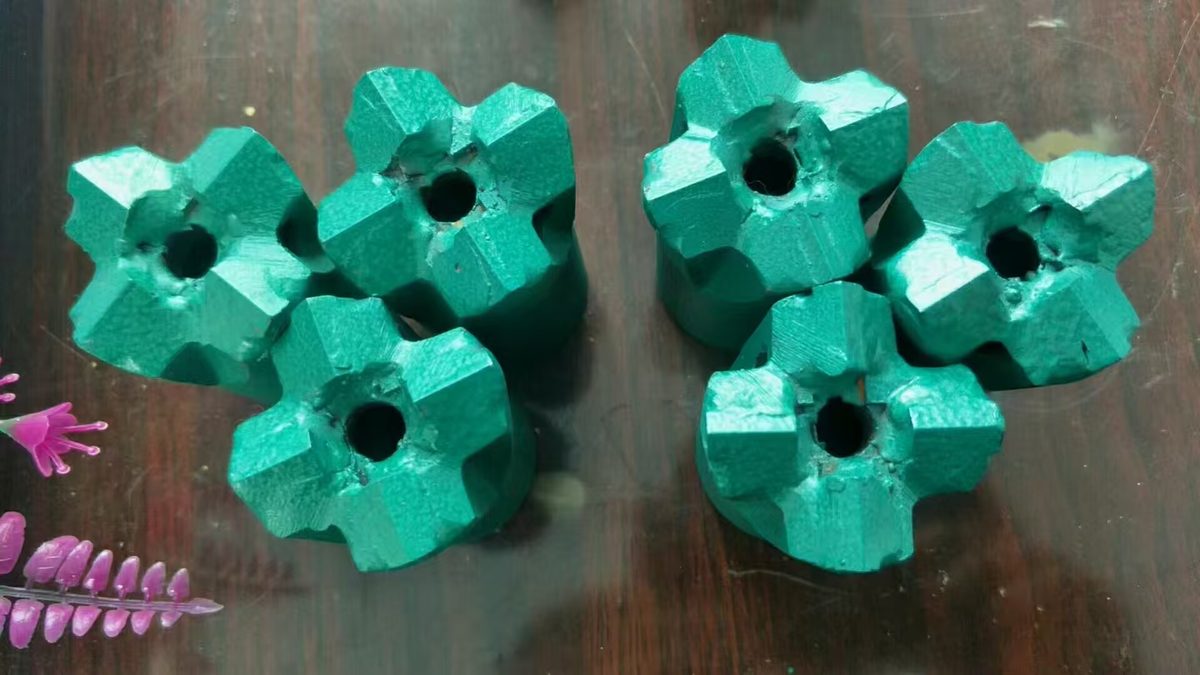
Order the same bit twice from two suppliers and it can arrive black, green, blue, red or bare grey – sometimes from the same factory. A drill bit colour code is part of the specification, but it is the least reliable part, and knowing what it can and cannot tell you saves a whole batch from being used in the wrong ground.
What the paint is really doing
Underneath the colour, every painted bit has the same job list:
- Corrosion protection. Drilling bits are steel and carbide, and they travel by sea. A primer or oxide coat keeps rust out of the thread and off the wing faces during months of storage and shipping.
- Batch and diameter identification. In a plant where dozens of similar bits are made in one shift, paint separates a 45 mm from a 50 mm bit at a glance.
- Grade or application marking. Some makers use colour to indicate which carbide grade or which coating a bit carries, or to separate bits intended for very different ground.
- Customer marking. Private-label bits are frequently painted to a customer colour, and the colour carries no technical meaning at all.
What colour cannot tell you
There is no universal colour standard in the drilling industry. Green does not mean hard rock, and red does not mean soft rock, in any binding sense. Two suppliers can both ship green bits with completely different carbide grades, or ship identical bits in different colours. Treat colour as a hint, never as a specification.
The same applies to oiled, waxed and bare-steel finishes. A heavily oiled bit is not automatically a better bit; it may simply be a bit that will sit in a warehouse for a year before it is used.
What to check instead of the colour
When a delivery arrives, the questions that actually protect you are mechanical:
- Gauge diameter – measured across the wing tips with a caliper, against the drawing.
- Wing symmetry – all wings the same length and profile, with no obvious casting or brazing defects.
- Carbide condition – buttons seated, no cracks, no visible gap at the braze line.
- Flushing hole – clear, round and on axis.
- Thread – clean, free from paint that has run into the flank, and seating properly on a known-good rod.
Paint inside a thread is a small detail with a large consequence: it changes the fit and can cause a joint to work loose. If a bit arrives with paint on the thread, clean it before assembly. Our quality control checklist sets out the full receiving inspection, and this article on carbide tips explains what the insert itself should look like.
Using colour the right way
There are two sensible uses. First, as an internal discipline: many plants repaint a batch on receipt to mark the ground it is approved for – green for clay work, blue for lining, for example – and never mix the stock. Second, as a fast visual check that the right box has come to the rig. Both are house rules, and both only work when the rule is written down and the drawing travels with the part.
If you are buying on colour alone – because a photo on a website looked right – you are buying the least informative part of the specification.
Frequently asked questions
Do painted bits drill differently?
No. The paint is cosmetic and protective. Performance comes from the steel, the heat treatment, the carbide grade and the geometry.
Should I remove the paint before use?
Only where it interferes with a fit – threads, seating faces and the inside of the flushing bore. Leave the rest; it protects the steel.
Will you match my existing colour?
Yes. If your stock is coded by colour or you need private-label marking for your own customers, we match it on request – just send the reference colour and the dimensions that must be checked.
Tell us the ground you are drilling and the diameter you need, and we will specify the geometry and carbide grade behind the colour – and paint it however your warehouse prefers.