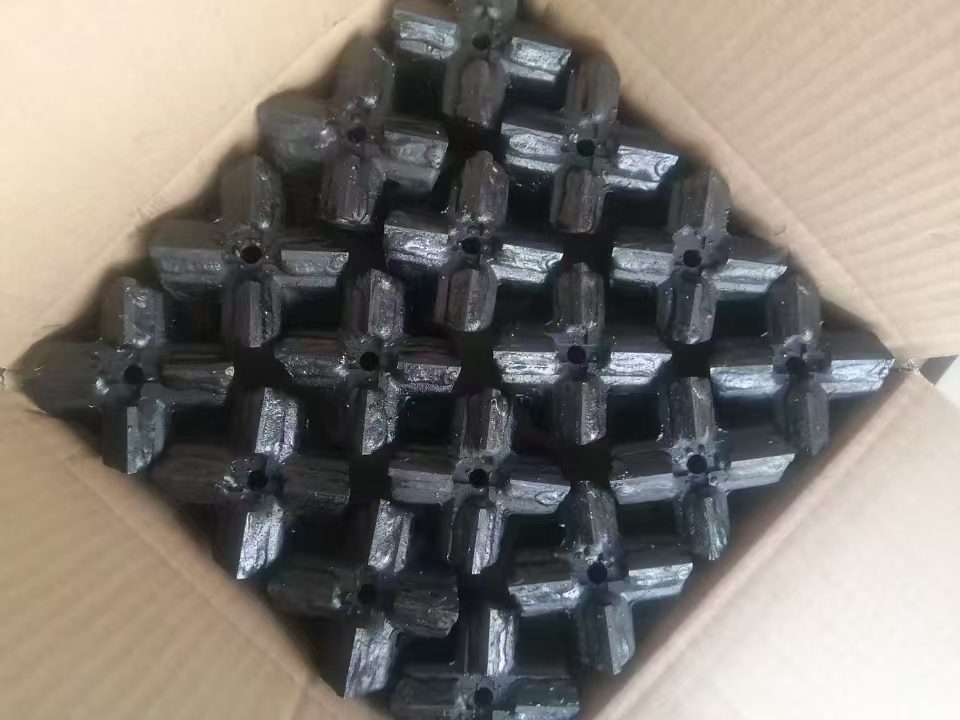
Nothing ruins a good price faster than a shipment of rusted threads and bent rods. Drill bits and rods are heavy, hard, and shaped exactly wrong for freight: pointed, threaded and prone to chipping each other. Packing is therefore not administration – it is part of the specification, and it belongs in the purchase order, not in an email two days before loading.
What kills a shipment in transit
- Moisture. Sea freight crosses climates. Steel in a container sweats, and a threaded joint with surface rust is a joint that will never seat properly again.
- Impact. Bits tipped into a loose carton chip each other’s carbide on the first bump. Missing buttons are the most common transit claim in this industry.
- Bending. Rods that are not supported or strapped bend under their own weight during handling. A rod with a slight bow drills an oversized, wandering hole.
- Mixed sizes. Loose parts of similar diameter in one box are counted wrong at destination and used in the wrong application.
How bits should be packed
A properly packed bit carton has three features: the bits are separated from each other, the cutting ends cannot touch anything hard, and the threads are protected.
- Bits are nested in a fitted carton, a moulded insert or a wooden plate so every bit sits in its own pocket.
- Caps or sleeves over the shank thread, and a light oil or anti-rust film on all machined surfaces.
- VCI paper or a desiccant bag inside the carton for long sea voyages.
- Carton or case marked with the part number, diameter, quantity and gross weight – in figures, not only in words.
For heavier or higher-value bits, a wooden case with internal dividers is normal and usually worth the extra cost; it is also the format most likely to arrive undamaged after three transshipments.
How rods should be packed
Rods are dense, so weight – not volume – is normally the limiting factor in a container. The packing job is to stop them bending and to keep the machined ends away from impact:
- Bundles strapped with steel banding at several points along the length, with timber or plastic spacers so the straps cannot crush the rod surface.
- Threaded or tapered ends protected with plastic caps or a wooden end board.
- Bundles blocked and braced inside the container so they cannot shift during a sea passage.
- Bundle length chosen to suit the container: rods that just fit are far easier to secure than rods with half a metre of slack.
Packing clauses to put in the PO
Copy these into your order and the argument at destination largely disappears:
- Packing standard and material: carton, wooden case or strapped bundle, with internal separation between parts.
- Thread and taper protection: caps required, oil film required, no exposed machined surfaces.
- Quantity per carton and per bundle, and total quantity per size – stated in figures.
- Marking: part number, diameter, quantity, net and gross weight, and your own shipping marks.
- Documentation: packing list with dimensions and weights, and photos of the packed goods before loading.
- Preservation period: how long the goods must survive in storage, which decides whether VCI paper and desiccant are needed.
- Inspection: whether you or your agent may inspect before the container is sealed, and whether a sample of each size must be included.
Two clauses that are often forgotten and worth adding: a requirement that bits of different diameters are packed separately, and a requirement that the packing list agrees exactly with the physical count. Counting discrepancies are the most common commercial dispute in this trade, and they are entirely avoidable.
Receiving the shipment: first hour
Before the container is emptied, photograph the load as found, check the strapping and look for signs of water ingress. Then unpack one carton per size and check the contents against the drawing and the packing list. Our quality control checklist covers the dimensions and features to check on each part, and this note on colour coding explains why paint is the last thing you should rely on for identification.
Frequently asked questions
Is wooden packing always better?
Not always. Some destinations require fumigated or heat-treated timber, and cartons with moulded inserts are often adequate for smaller bits. The deciding factors are weight, transit time and how much a damaged part costs you.
Should rods be shipped in one bundle size?
Keep bundles to a weight that one person with a crane hook or two people can handle safely, and keep lengths consistent within a bundle. Mixed lengths in one bundle almost always arrive mixed up.
Who pays for packing?
Packing is normally quoted as part of the unit price, and the honest way to compare offers is to state the standard you require first and then compare quotations against it. An unexplained low price usually means someone removed the internal dividers.
Tell us your destination, transit time and storage conditions, and we will quote a packing standard that gets your bits and rods to the hole unmarked – with photos of the packed goods before the container is sealed.