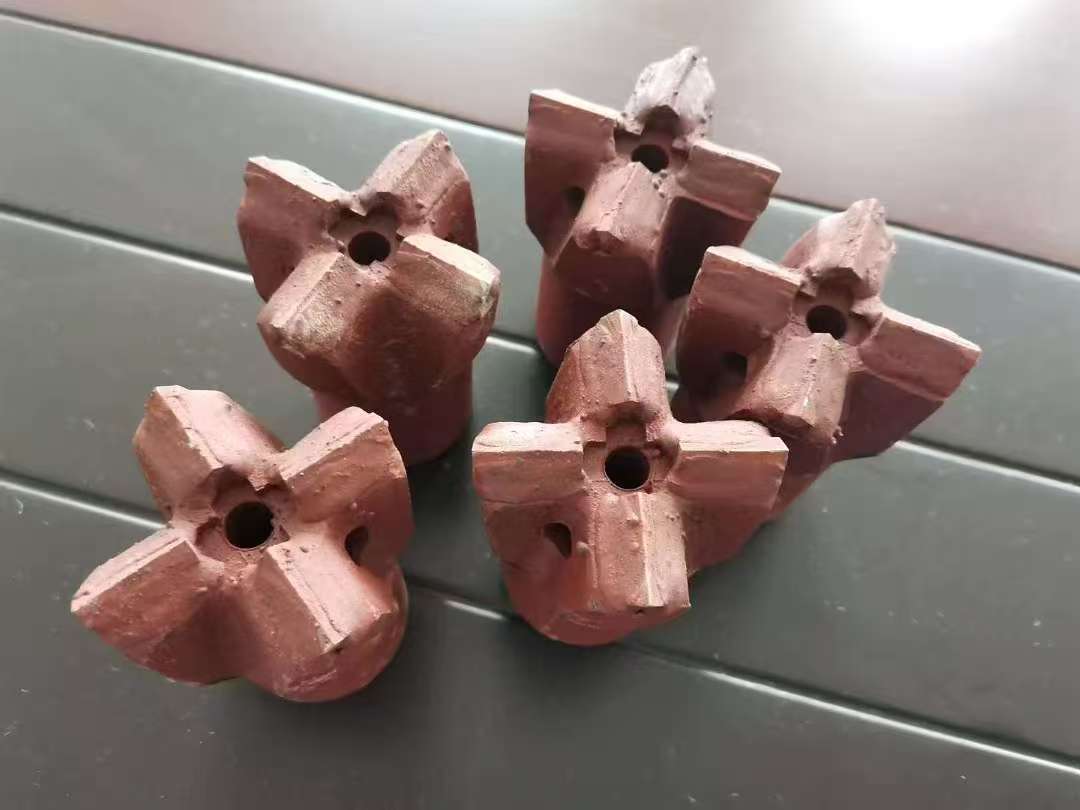
Standing in front of a blast furnace tap hole, the most eye-catching part is not the long drill rod but the bit at its tip. The most widely used bit in BF tapping is the cross-type (or four-wing) bit. It looks like a symmetric four-wing cross, with a central flushing hole and tungsten-carbide buttons inserted on each wing.
Its working principle is straightforward: as the opening machine rotates the rod and feeds forward, the carbide buttons on the four wings crush and scrape the tap-hole clay, mud-gun mix and solidified lining layer by layer. Because the cross shape provides cutting edges in all 360 degrees, the bit does not drift sideways, producing a straight, stable-diameter hole—ideal for tap-hole drilling where one clean pass is required.
The central flushing hole is a key design. High-pressure water or air flows through the rod bore to this point, directly cooling the button tips and carrying crushed cuttings back through the annular gap between rod and hole wall. If the flushing hole clogs, bit temperature rises quickly and wear accelerates dramatically.
The red, orange or white paint on the bit is not decoration: it is anti-rust and identification paint. Different colors usually mark different carbide grades, bit diameters or service conditions. When replacing a bit on site, check not only the thread size but also the color code, to avoid using a soft-rock bit on hard tap-hole clay, which would chip the buttons in a few strokes.