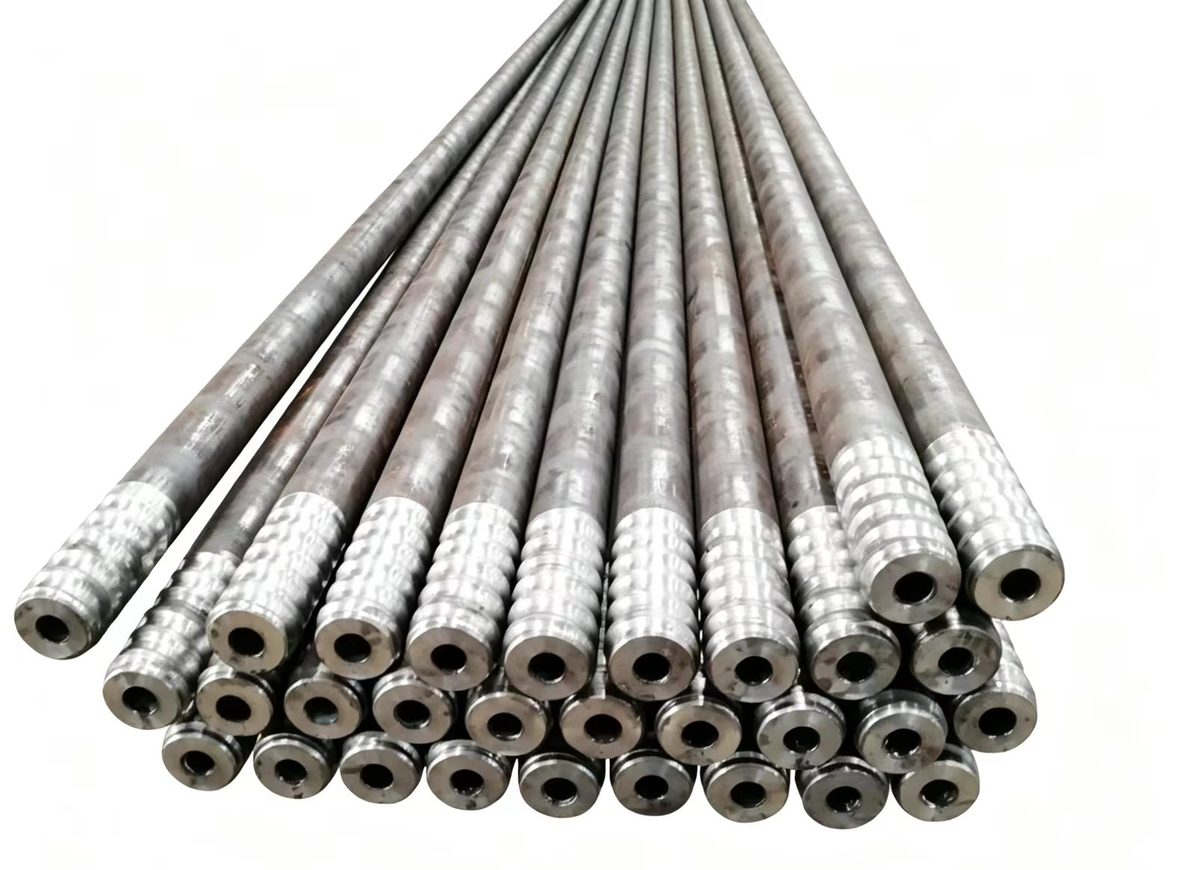
Buyers spend hours comparing rod steel, heat treatment and diameter, and then specify the shank almost as an afterthought. Yet the shank is the part that grips the machine, takes the rotation torque and absorbs the rebound of every blow. Get it wrong and nothing else about the rod matters.
What the shank actually does
The shank is the length of rod that goes into the drill. Three things happen there: the chuck grips it and turns it, the piston strikes the end of it, and flushing fluid enters through it. So the shank has to be dimensionally accurate in section, in length and in the bore.
Hexagonal shanks
Hexagon sections dominate hand-held rock drilling. The flats give the chuck jaws something positive to grip, so torque can be transmitted without slipping, and the same flats let the drill string be rotated by hand when collaring or when a rod sticks.
The common sizes are the 22 mm hexagon shank, usually 108 mm long, and the 25 mm hexagon shank, usually 159 mm long. Which one you need is decided entirely by the drill – never by the rod you happened to have in stock. A 25 mm shank will not enter a 22 mm chuck, and a 22 mm shank in a 25 mm chuck will slip, heat up and hammer the chuck jaws out of shape.
Round shanks
Round shanks appear on heavier machine drills, on drifting equipment and on rods where the rotation is transmitted by a threaded or splined coupling rather than by chuck jaws. They carry higher torque and are stiffer, which matters as hole depth and rod length increase. Round rod strings are usually threaded end to end, with the connection carrying both the torque and the thrust – which is why the thread form and shoulder geometry matter so much on this type.
Hollow versus solid
Almost every rock drilling rod is hollow, not because hollow steel is cheaper but because the bore is the flushing channel. Water or air travels down the bore, out through the bit, and back up the outside with the cuttings. Without it, the cutting edges overheat and the hole fills up.
Solid rods exist for short rotary work and for some auger applications where the cuttings are carried by the flights rather than by fluid. If you are choosing between them, the question is simple: does the hole need fluid to clear and cool? In rock, the answer is always yes.
Reading a shank before you order
Take four measurements from the machine, not from the old rod, since the old rod may be worn:
- Chuck aperture and section – hexagon across flats, or the diameter for a round chuck, plus the depth to the strike face.
- Grip length – how much of the shank the jaws actually hold.
- Strike face – the shape and diameter of the end that the piston hits.
- Bore size – the flushing hole diameter that the machine’s water or air swivel feeds.
If a rod is worn in the chuck, the measurement tells you which part: a shank that is undersize across the flats means the chuck jaws are slipping, which is a chuck problem as much as a rod problem.
Where rod life actually ends
Three zones fail, in this order: the shank (hammered, oval, cracked at the collar), the thread or taper (worn, galled, cross-threaded), and the body (bent, worn thin at the couplings). Only the second of those is covered by rod selection – which is why thread matching and shank specification have to be done together. Choosing the right steel grade is also part of the picture; see 42CrMo versus 40Cr drill rod.
Frequently asked questions
Can a round shank be used in a hexagon chuck?
No. The chuck transmits rotation through the flats; without them it cannot grip and will simply spin and damage both parts.
Does shank length affect drilling performance?
It affects how the piston energy is delivered. A shank that does not reach the strike face properly wastes part of every blow and quickly damages the end of the rod.
How do I know when a shank is worn out?
Measure it. Across-flats should be within the manufacturer’s tolerance, the strike face should be flat and free of mushrooming, and there should be no cracking at the collar. In practice a rod is retired when the shank stops holding, and that is normally well before the body fails.
Photograph your chuck and measure it, or send us your drill model, and we will match the shank section, length and bore so the rods drive properly from the first blow.